 By
By Author: Anna Kim (McGill University)
Interviewer: Marselia Tan (ESSEC Business School)
Article link: https://doi.org/10.1177/00018392241303580
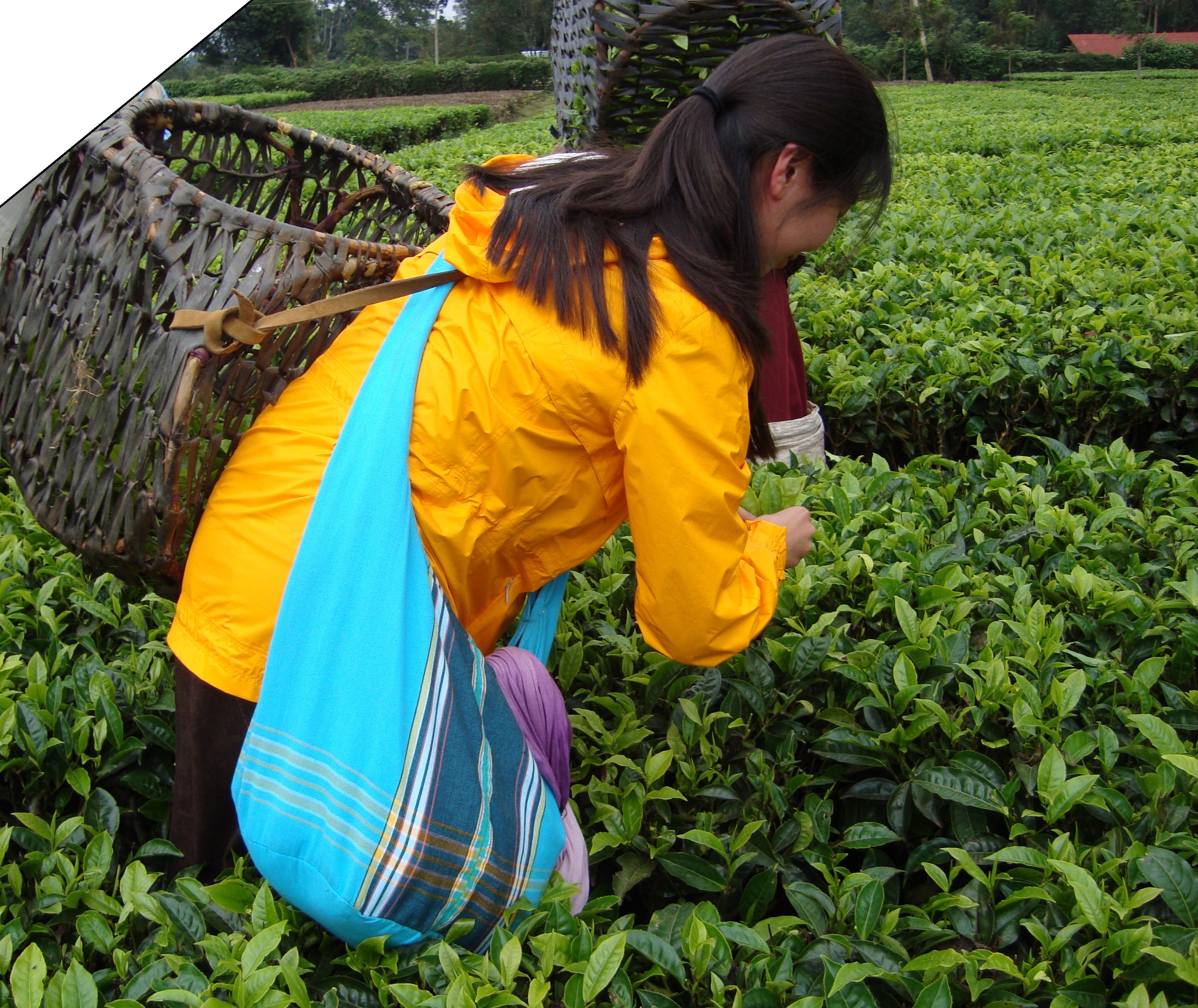
Image Source: Anna Kim picking tea leaves during her fieldwork in Kenya. By hand-plucking tea leaves alongside tea farmers, she was able to experience the farmers’ work and carry out conversations while helping with their work. The leaves she picked would be weighed together with tea farmers’ leaves for payments, making small contributions to their income.
Could you walk us through the background of how this paper came to be? I’m interested to learn about what you thought you were studying when you first entered the field, and how that changed over time.
Indeed, it changed. In the field, we often see something very different from what we expected to see, and that’s the beauty of field research. Usually, that’s where the most important or interesting findings are. If we see exactly what we had expected to see, we don’t go very far, because that probably means that it was somewhat already known to us or others.
“In the field, we often see something very different from what we expected to see, and that’s the beauty of field research.”
This paper was part of my PhD dissertation. I thought of it as one big project and didn’t necessarily think of it as different papers. I always thought I would go to different tea farming communities in Kenya, Uganda, and Tanzania, all certified by Fairtrade or working towards certification. I was thinking about it as one big study of nine different communities. My motivation was to go to these communities with a very open mind and understand how they were experiencing Fairtrade from their perspectives: what’s working, what’s not working, what’s creating benefits, and what’s creating an additional burden—with how and why.
Initially, I meant to write about all nine communities together. However, I realized one community was so different—the Kipsigis community you read about. Before the fieldwork, I might have thought what differed was that they were at an earlier stage of certification, but it became clear that what really mattered were all the things you read about: the history, the negotiations… these were totally different dynamics. I still remember when I first came back from the first round of fieldwork, the first thing I was telling everyone was that I might have to rethink the whole thing because I don’t think one story fits with the others. So, I had to separate this case out. I wrote one paper about eight communities, and I wrote this one about the Kipsigis community, with no overlapping data between the two papers.
When this paper was still a dissertation chapter, the storyline was different in its theoretical framing, which had three main iterations. Iteration number one put more emphasis on negotiations, and that was my dissertation chapter. Iteration number two put more emphasis on history, and that was the initial submission to ASQ. Iteration number three is pretty much what you see now. The actual story never changed; it’s just the framework. The story was always about their agency and how they were negotiating in the historical context. I think I never actually moved away from negotiations or history because in my mind, they are still there. I’m very happy I ended up emphasizing the agency of the target beneficiaries, and the triadic perspective even more, because that was the core anyway. I felt I gained more space to really highlight what I wanted to highlight without losing the aspects about negotiations or history.
Your passion and care really shone through in this paper. I really enjoyed reading about the relationships you had built, as well as how your and your grandparents’ own experiences shape your connection and understanding with the Kipsigis tea farmers. Could you share more about how you build trust with people you study?
It’s interesting because I asked that question to myself. Why me? How could I have been given the opportunity to listen to all these stories? The most important thing is that these are fundamentally human relationships. You really cannot be strategic about these things. You don’t strategically build trust in order to access high-quality data. It doesn’t work like that. It doesn’t work like that in most contexts, and it doesn’t work like that especially in this kind of context. I tend to be myself pretty much wherever I go anyway. I talked of course, about my research, but I was also talking about my family in South Korea. You may have noticed that the acknowledgement section of the paper included my grandparents. Korea was colonized by Japan. My grandparents were extremely poor peasants who were part of the resistance movement. My grandfather was someone who could be seen as a village leader. And at that time, if someone was resisting the colonizer, it was important from the colonizer’s perspective to properly torture and imprison them if they were intellectual, well-educated people. But for farmers and peasants, it’s not even worthwhile for them to imprison, torture, or put them through trials. So, they were buried in snow, alive, assuming that they would die. My grandfather survived, but obviously, he suffered for the rest of his life and couldn’t live a very long life.
“These are fundamentally human relationships. You don’t strategically build trust in order to access high-quality data. It doesn’t work like that.”
Since I came from these kinds of memories, some things that may not be visible to those who may not have had this kind of intergenerational trauma and post-colonial experiences are very visible to me. Of course, every experience is different, because every colonization is different, but it’s always devastating. In the process of hearing about the Kipsigis farmers’ experiences and talking about my family, of course I cried, and they cried. And no decent human being ever does something like that just to be able to access high quality data or anything like that, right? That’s not how these things work. But through a human process, I ended up talking about these things and they ended up talking about their stories. There are circumstances and histories each of us just happens to have. I might have heard the stories I could hear because of those connections… some of these things may not have been available to other people coming from different backgrounds. But I’m sure there are things other people can see and stories they can hear that I cannot in the same way.
“There are circumstances and histories each of us just happens to have. I might have heard the stories I could hear because of those connections… but I’m sure there are things other people can see and stories they can hear that I cannot in the same way.”
In this research, you were making conscious decisions in how you travel, eat, drink, sleep, where you stay, and generally staying in frugal living conditions. Could you share how these help with your immersion in the community and how did you make these decisions?
My rule of operation was very simple: I do it in a way they would do. Hence, I never needed big money. In fact, it was very important to me that I never had a large budget. I would never hire a private vehicle, which a lot of researchers including PhD students do in this context because when you do the currency conversion, it feels cheap. Some also think it’s safer. But, having more money would have been counterproductive because you would be tempted to spend it on expensive rooms, on private cars.
People often appreciated that I learned Swahili for fieldwork, but other foreigners working for NGOs long-term also speak Swahili. What mattered much more to most people in the rural villages was that they had never seen a foreigner travel by matatu or stay in local, inexpensive inns. This goes back to the question of trust. They wouldn’t share these kinds of intimate stories with someone staying in a nicer hotel and traveling by car. It gave me the opportunity to embed myself into the community. And generally, this is also part of my background. I grew up in Korea without much money. I worked in a factory and on shop floors; I worked on part-time jobs since I was 12. I can live very cheaply, so I didn’t mind. Once again, none of this was a strategic calculation to access better data. I did it partly as a way of respect. I didn’t want to be the person who could afford all these things and flash money around. I had the mindset that I shouldn’t be that person.
So, actually, I needed very little money. I just needed the flight tickets. But to live there for months, you don’t need much. Flying between Nairobi and London, that required a plane. But I didn’t fly within the region to travel from one community to another because ordinary tea farmers wouldn’t. When going from Kenya to Uganda to Tanzania, I traveled by road or by the night ferry on Lake Victoria, which is exactly how local farmers and workers would travel. Whenever I arrived, people already knew about “this crazy foreigner” who crossed the lake or travelled by long-distance bus or matatu with some community members. What that meant also was that I was hearing stories all the time.
After spending a long period of time being embedded in the communities and being deeply connected through difficult and traumatic histories and experiences, how did you navigate the process of exiting this field? Since, as researchers, there is a need to also spend the time and space to do the writing.
Oh yes, I have a very quick answer to that. Because I actually never meant to exit. That’s the short answer. I meant to go back, but I became pregnant at that time. And the community were super happy for me that I will have a baby! So basically, the short answer is I meant to go back, and I still intend to go back, so I never exited the field in that sense. Once again, it’s about human relationships.
I understand the methodological concept of exit, and I understand that now that this paper is out, it’s probably seen that I had exited, and I can accept that notion, but in my mind, it’s my relationship. I don’t exit my relationship. Who exits a relationship, unless I die? So, I meant to go back. They know it, and they always say, “you should come back.” So, you’re right in the sense that we need to decide at some point to write up a story or paper or dissertation, based on timelines and other factors. And the closure of that chapter needs to be properly communicated with study participants, sharing findings and so on, all that process is very important. But I see this as a lifetime relationship. When I feel that at some point, I have a story that’s enough to be written, I will be writing. But that doesn’t end my relationship with these people. My brain doesn’t work like that.
Could I ask the process of how you share your research findings back to the community? How do you usually share your work with the people you met in the field?
Yes, I do, but in different ways. And not just at the end, I share along the entire process. But it depends on the contexts. For example, for people in Canada, for different projects that I have done, it can involve sending drafts and getting comments and discussing them. And of course, they have the final paper as well. In this context in Kenya, in the community, it’s a little different, because the 40 pages of English text may not matter much to many people there. With some of them, such as managers of tea factories or people who read English, I shared texts along the way. Especially when I have some paragraphs about that particular community, I would always send them. And I would ask “What do you think? Does it make sense? Do you have anything to say? Do you want me to say anything differently?”
In the Kipsigis community, as a lot of things were verbal, when I was in the field, I would talk about what I was going to write about, because I almost see it even more as their story than my story. So of course I do the write-up, I do the sense-making, but it also has to make sense for them. So I shared with them even though, of course, the whole story wasn’t there yet, I shared it along the way. And they often also appreciated learning about other communities as well, because what I brought was a kind of an opportunity for them to learn about other communities. So they were always curious about, “What are you writing about Uganda, and what are you writing about Tanzania?” and I would share. So, you may call it workshops. It’s not, of course, formal presentations. But we would talk, and I would always talk about what I was writing, what I’m writing, what I’m going to write, and I would get their inputs to make sure they are comfortable. For example, some of the stories I wrote were about how they are saying different things to different people. So I wanted to make sure that they were comfortable with me sharing that.
The answer is yes, I do share, but it can happen in different ways, because sometimes just sending a file doesn’t mean much.
A key strength of the study is the richness of the data. For a PhD student or early-career researcher who may be feeling daunted by a similarly “messy” dataset, what can help in staying organized with data?
I certainly had that tendency to document things I do. For instance, outside of research, I tend to organize things. I actually became more disorganized after my baby was born, after becoming a parent! But I tend to be organized, and the habit of organizing can almost cross over domain, not just about academic research. Someone who is good at keeping track of things, whether organizing reports, taking care of calendars, or if you are doing research, these habit and skills are quite transferrable. This was always part of my life and hence was what I was doing for my data. I kept track of place I was going to, how many hours in matatu, how much I spent. It was helpful because I had of course a lot of field notes, which includes not just stories but time stamps and indicators.
I’m not always a big fan of quantifying qualitative data, as a lot of things can get lost in the process, but at the same time, this is part of the transparency. It’s not necessarily because the longer the better, or the more the better. But still, some counting and documenting, when not too excessive, give a sense of engagement and transparency. It gives readers confidence about our engagement in the contexts we are studying. For example, my context is agricultural communities, so here, seasonality matters a lot. If someone spends a lot of time there but always in rainy or dry season, they may not get the sense of how things change across seasons. My point is, giving this kind of information lends confidence to readers and reviewers that your field engagement and data support what you are trying to say.
How was your experience in submitting the paper, navigating the review process, rewriting it, at ASQ?
Initially I sent an early version of this paper, with the history emphasis, to the Academy of Management Conference, and they gave me the OMT Best International Paper Award and a nomination for the Carolyn Dexter Award. It was surprising to be receiving this pretty big recognition, because I was working for a long time all alone since my dissertation. After my presentation at the conference, several people from the editorial board told me that I have to send it to ASQ. I thought, okay, it’s probably going to be rejected, but I’m going to send it anyways.
During the review process at ASQ, I was very grateful that I was allowed to take time for revision compared to some other journals because I needed time, especially for this paper. It took me a long time to just process the data. Whenever I’m in the data, I cry. I cry like crazy. I can’t just work on it for three hours; I have to shut down. I need two, three, or four weeks dedicated to this paper, and my family and friends know that when I’m “with the Kipsigis paper.” This is a community of extreme poverty and trauma, where people were dying from hunger and had to exchange children for food, as that was the only way both parents and children could survive. They saw their parents and grandparents killed when the company came in the 1920s. So, for years, I was in and out of this paper as I needed time. It was also a time when I was managing full-time work and full-time childcare responsibilities during the Covid-19 pandemic and subsequently dealing with major health issues. I was really lucky to have amazing reviewers and handling editor who were patient, constructive and open to this kind of data and somewhat unconventional approach. The ASQ review team and my editor, Mike Pratt, were very open to a less conventional approach, allowing me to lighten the theories around history and negotiations to really highlight what mattered to me. They were sympathetic, open, and they considered this phenomenon as something important.
As early-career scholars, we’re often advised to develop a clear research identity, but your career seems to exemplify how a core curiosity and passion can open a rich set of meaningful questions. As you mentioned, this paper was from your dissertation research as a PhD student. How did your research interests evolve from your dissertation to current projects? How was the evolution of your scholarly research identity? And, what advice do you have for us on nurturing a research identity to junior scholars?
I think a lot of us actually have that already. Of course, it will evolve and develop, but nobody just comes to a PhD program without thinking about what kind of topic or phenomenon or approach they’re interested in, right? So, in that sense, almost every PhD student, even from day one, would have something that can be called as some sort of research identity. They may not have a full dissertation topic and research design all set up, but they must have something. It can be theories from readings they were exposed to sometimes, other times it can be even more about contexts where they might really have passion for writing and researching, such as in certain geographies or industries.
But it takes a lot of work to really nurture or develop what you already have. Sometimes when other people don’t appreciate or understand the value of what you already have, it might be partly because they don’t understand, but also it might be partly because you have not fully been able to nurture what you have to a point you can communicate it in a way that feels important to other people.
When I started my PhD, I maybe explained my research by saying, “I want to work with tea farmers in Kenya, Uganda, and Tanzania, to understand their perspectives and experiences of Fairtrade.” This may sound very specific; some people might say that this is just geographic contexts and doesn’t have anything to do with research identity. Over time, I learned to nurture and develop this. The core of my work remained the same. But I learned to frame it in a way that speaks to broader issues. Framing it around community agency and co-creation of social impact, especially considering that even well-intended social impact initiatives often backfire in the local context, makes the importance of the research clearer to a wider audience. My interests in local-global dynamics of Fairtrade and long-term community impact in the context of immediate needs and resource constraints also evolved to my approach of exploring sustainability through the lens of time-space. But the essence never changed. In fact, that’s exactly why the East African tea farmers’ perspectives and experiences of Fairtrade mattered to me in the first place.
If I had actually listened to these people to think that, “Oh my god, this is only a research context, and my research identity should be something completely different, like one of well-established theories,” then my papers and my research wouldn’t be here, at least not in the same form. But I was staying with this idea that there’s something important here, and if it feels very important to me and a bunch of other people, there must be a reason, right? If you feel that this is something worthwhile to invest at least three, four, five, six years of your time, depending on the duration of your PhD, there is probably something important there. So, I think PhD students need to work on that. To develop, nurture, grow that in a way that hopefully speaks to other people in important ways as well. But at the same time, it doesn’t mean that you’re moving away from what you already have. You already have it, but it’s just not fully there in a way you can express, in a way that is so obvious to everyone else. But that’s a process. But that seed is already there – otherwise, who would start a PhD without that? It just doesn’t make sense. I hope many doctoral students and junior scholars will enjoy the process of nurturing that seed they already have, to grow and flourish. I also see it as an open-ended process, so I hope I’ll continue to learn and grow in my journey.
Interviewer Bio:
Marselia Tan is a PhD candidate in Management at ESSEC Business School, France. She is a qualitative researcher studying macro-level, longitudinal, or historical phenomena on dynamics of market and technology emergence, evolution, and decline. She is especially interested in how organizational and social movement actors attempt to change entrenched production and consumption practices in the face of social and environmental challenges. Marselia is a member of the Ethnography Atelier, a collaborative space that promotes ethnographic and other qualitative research in work and organizations.