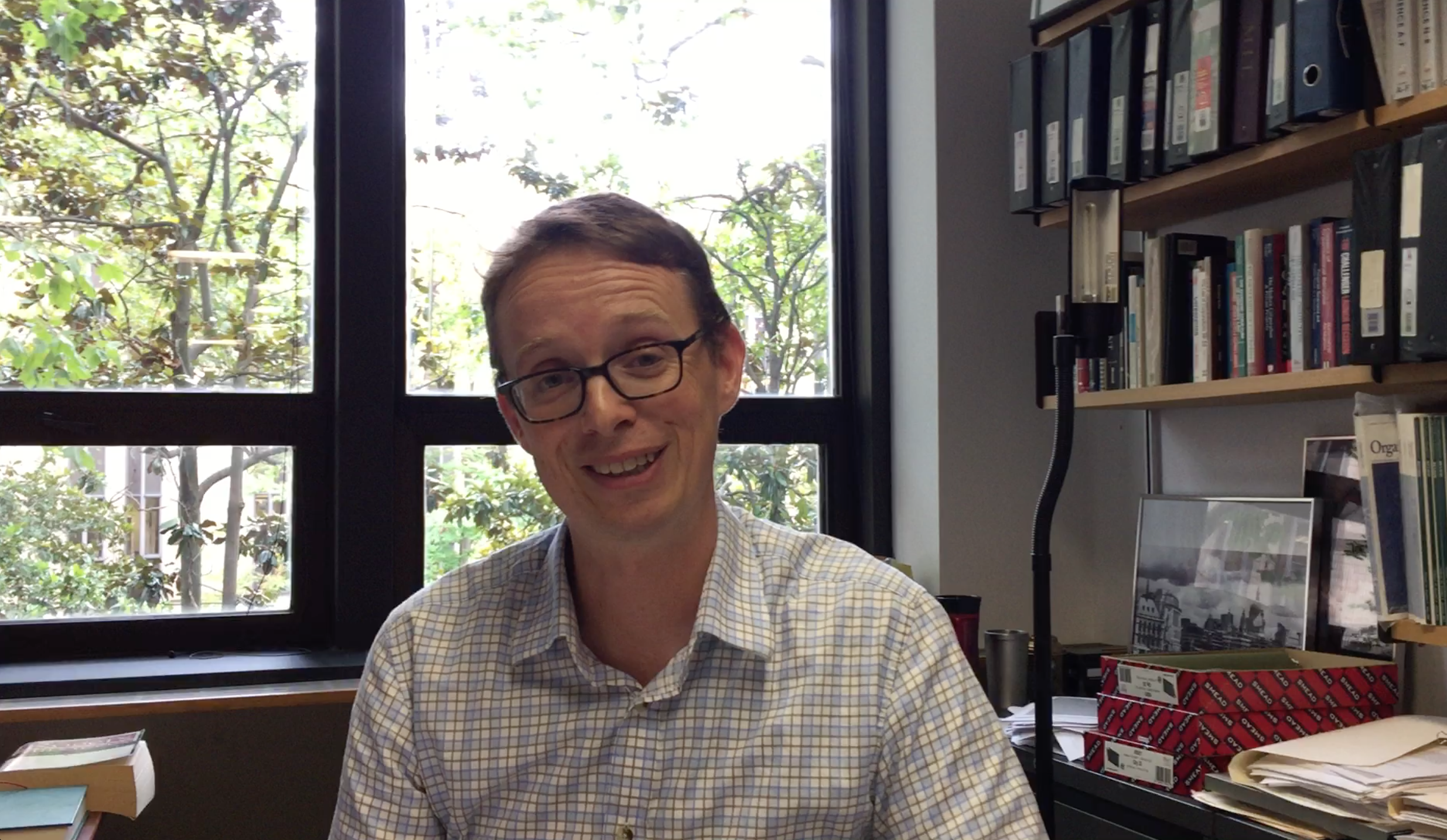
Our ten most-read posts of 2017, led by a New Year conversation with editor Henrich Greve, the editorial office's Thanksgiving writing tips, and ...
ASQ Interview
Carlos & Lewis (2017). Strategic Silence: Withholding Certification Status as a Hypocrisy Avoidance Tactic
Chad Carlos noticed something odd in a seminar dataset: hotels that had earned costly ecotourism certifications weren't mentioning them anywhere. He and Ben ...
ASQ Podcast
PODCAST: Botelho & Abraham (2017). Pursuing Quality: How Search Costs and Uncertainty Magnify Gender-based Double Standards in a Multistage Evaluation Process
Tristan Botelho and Mabel Abraham join the podcast to discuss gender double standards in multistage evaluations, and Abraham's push to move past documenting ...
ASQ Video
A Conversation with Matthew Bidwell, winner of the 2017 ASQ Award for Scholarly Contribution
Matthew Bidwell, winner of the 2017 ASQ Award for Scholarly Contribution, sits down on video to revisit how 'Paying More to Get Less' ...
A running collection of resources for ASQ's evidence presentation initiative, including AOM workshop slides from editors and authors on visualizing data, numerical narrative, ...
A Thanksgiving special from the ASQ editorial office: writing advice for submissions, what a theoretical contribution actually requires, and why filling a gap ...
ASQ Interview
Anteby (2010). Markets, Morals, and Practices of Trade: Jurisdictional Disputes in the U.S. Commerce in Cadavers
An anatomist once shouted 'Catch!' and threw Michel Anteby a plastinated body part, testing him for disgust. Anteby recounts studying the U.S. cadaver ...
ASQ Interview
Bermiss & Greenbaum (2015). Loyal to Whom? The Effect of Relational Embededdness and Managers’ Mobility on Market Tie Dissolution
When a trusted manager defects to a rival firm, which relationship do clients keep? Sekou Bermiss and Bruce Greenbaum studied lobbyists to learn ...
ASQ Interview
Rogers, Corley & Ashforth (2017). Seeing More than Orange: Organizational Respect and Positive Identity Transformation in a Prison Context
At a business school award luncheon, Kristie Rogers watched Televerde's CEO credit respect for the success of his inmate-staffed call centers. With Kevin ...
ASQ Podcast
PODCAST: Brands & Fernandez-Mateo (2017). Leaning Out: How Negative Recruitment Experiences Shape Women’s Decisions to Compete for Executive Roles
Raina Brands and Isabel Fernandez-Mateo discuss why bruising recruitment experiences lead women to stop competing for executive roles, and what the Lean In ...
ASQ Interview
Sasovova, Mehra, Borgatti & Schippers (2010). Network Churn: The Effects of Self-Monitoring Personality on Brokerage Dynamics
Why study friendship networks rather than advice ties? Zuzana Sasovova, Ajay Mehra, Stephen Borgatti, and Michaela Schippers defend that choice and describe how ...
ASQ Interview
Dalpiaz, Rindova, & Ravasi (2016). Combining Logics to Transform Organizational Agency: Blending Industry and Art at Alessi
How did Alessi turn kitchenware into applied art without being punished for crossing categories? Elena Dalpiaz, Violina Rindova, and Davide Ravasi discuss failed ...
ASQ Interview
Truelove & Kellogg (2016). The Radical Flank Effect and Cross-occupational Collaboration for Technology Development during a Power Shift
Emily Truelove and Katherine Kellogg walk through the countless drafts behind their radical flank paper, including reviewer orders to swap an empirical puzzle ...
ASQ Interview
O’Mahony & Bechky (2008). Boundary organizations: Enabling collaboration among unexpected allies
Siobhan O'Mahony and Beth Bechky revisit a moment when corporate America courting open source communities was genuinely shocking, and explain how boundary organizations ...
ASQ Interview
Azoulay, Repenning, & Zuckerman (2010). Nasty, Brutish, and Short: Embeddedness Failure in the Pharma industry
Pierre Azoulay's 1999 company visits were meant as mere background for a statistical dissertation. He, Nelson Repenning, and Ezra Zuckerman recount how that ...
ASQ Interview
Fayard, Stigliani & Bechky (2016). How nascent occupations construct a mandate: The case of service designers’ ethos
What began as a one-year exploratory study of service design stretched to five. Anne-Laure Fayard, Ileana Stigliani, and Beth Bechky describe how reviewers, ...
ASQ Interview
Cobb & Stevens (2017). These Unequal States: Corporate Organization and Income Inequality in the United States
Adam Cobb and Flannery Stevens argue that where large firms employ fewer people, state income inequality rises. The idea traces back to Jerry ...
ASQ Podcast
Greenberg & Mollick (2017): Activist Choice Homophily and the Crowdfunding of Female Founders
Ethan Mollick joins the podcast to explain a puzzle he and Jason Greenberg chased: why women outperform men on Kickstarter, and why they ...
ASQ Interview
Dutta (2017): Creating in the Crucibles of Nature’s Fury–Associational Diversity and Local Social Entrepreneurship after Natural Disasters in California, 1991–2010
Why do some communities answer natural disasters with a burst of social entrepreneurship? Sunasir Dutta points to the variety of local voluntary associations, ...
ASQ Interview
Flynn, Chatman, & Spataro (2011). Getting to Know You: The Influence of Personality on Impressions and Performance of Demographically Different People in Organizations
Francis Flynn, Jennifer Chatman, and Sandra Spataro flip the usual question about stereotyping: instead of studying perceivers, they ask whether extraverted, self-monitoring targets ...
ASQ Interview
Yue, Luo & Ingram (2013). The Failure of Private Regulation: Elite Control and Market Crises in the Manhattan Banking Industry
Writing from Columbia during the 2008 crisis, Lori Yue, Jiao Luo, and Paul Ingram looked back to 1907, when Manhattan's banking elite let ...
ASQ Interview
Bidwell (2011). Paying More to Get Less: The Effects of External Hiring Versus Internal Mobility
Reading statistics on the cost of replacing workers, Matthew Bidwell kept wondering how anyone actually knew. The answer became a paper showing that ...
Does guanxi fade as markets mature? Heather Haveman, Nan Jia, Jing Shi, and Yongxiang Wang found the opposite in China, where state power ...
ASQ Interview
Chen & Nadkarni (2017): It’s about Time! CEOs’ Temporal Dispositions, Temporal Leadership, and Corporate Entrepreneurship
Strategy research long treated time as an external constraint imposed on executives. Jianhong Chen and Sucheta Nadkarni explain why they went looking inside ...
ASQ Interview
Jordan, Sivanathan & Galinsky (2011). Something to Lose and Nothing to Gain: The Role of Stress in the Interactive Effect of Power and Stability on Risk Taking
What do destabilized baboon hierarchies have to do with executive risk-taking? Jennifer Jordan, Niro Sivanathan, and Adam Galinsky trace their study of power, ...
ASQ Podcast
Gupta & Wowak (2017). The Elephant (or Donkey) in the Boardroom: How Board Political Ideology Affects CEO Pay.
Abhinav Gupta and Adam Wowak join the podcast to discuss how directors' political ideologies shape CEO pay, and how Federal Election Commission records ...
ASQ Interview
Leahey, Beckman, & Stanko (2016). Prominent but Less Productive: The Impact of Interdisciplinarity on Scientists’ Research
Interdisciplinary research wins citations but costs productivity. Erin Leahey, Christine Beckman, and Taryn Stanko discuss that trade-off, why their sample couldn't answer the ...

ASQ editor Henrich Greve opens the blog's 2017 in a video interview about what the journal is doing to stay impactful and his ...